The EDAIC Part I Is Not a Normal MCQ Exam — Here Is How to Think Through MTF Questions
The EDAIC Part I is not like any other postgraduate exam most trainees have sat. The question format — Multiple True/False, or MTF — is fundamentally different from the Single Best Answer format used in the FRCA and most other modern medical exams. The approach that works for SBA will actively mislead you here.
Here is what changes.
What EDAIC Part I MTF Actually Is
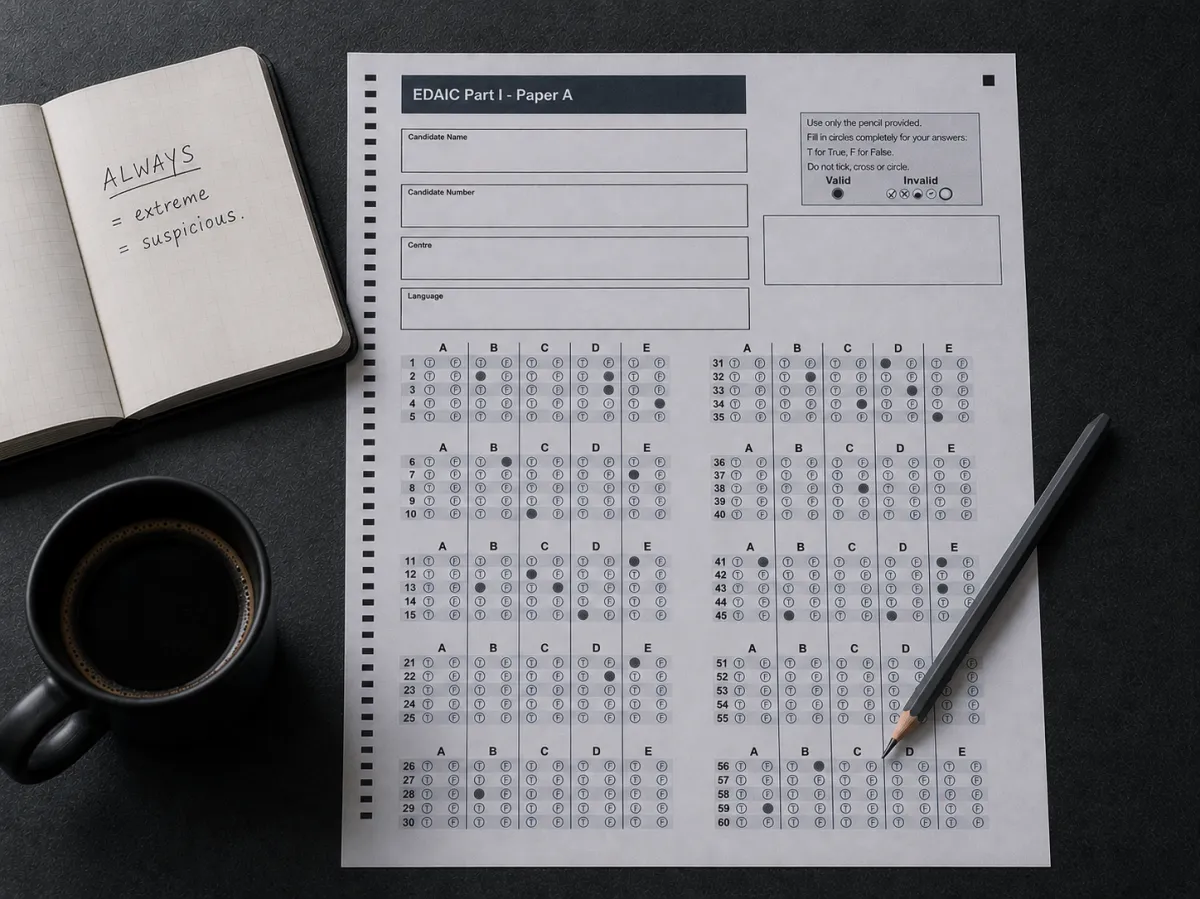
Each question consists of a stem — a clinical or scientific scenario — followed by five statements. Each statement is independently true or false. You mark T or F for each of the five.
This is not “pick the best answer.” It is not “which two of the following are correct.” It is five separate binary judgements on five separate statements. One mark each. Maximum five marks per question.
That distinction matters more than most candidates realise.
The No Negative Marking Rule
The EDAIC Part I has no negative marking. One mark for each correct statement. Zero for an incorrect or blank answer.
The implication is absolute: always answer every statement. There is no strategic reason to leave any statement blank. If you do not know, guess — your expected return on a random guess is 0.5 marks. If you leave it blank, it is zero. Always answer. Every single statement.
This alone separates the EDAIC from exams where leaving uncertain answers blank is defensible. Here it is never defensible.
How to Approach Each Statement
The temptation in MTF is to read the stem, form a general impression, and let that impression colour your judgement on all five statements. This is the trap.
Each statement must be evaluated independently. The stem creates context; the five statements are scored individually.
Work through them like this:
- Read the stem fully — once
- Move to statement 1. Cover statements 2–5.
- Evaluate statement 1 on its own: is this true or false as written?
- Mark it. Move to statement 2.
- Repeat.
Do not let statement 1 influence your reading of statement 3. Do not try to make the five statements tell a coherent story — they are not required to. Three true and two false is as valid a question as five false.
Handling Borderline Statements
Every candidate encounters statements where they are not sure. The instinct is to second-guess, flip the answer, or leave it blank.
None of these is the right move.
When genuinely uncertain: ask whether the statement is generally true or generally false in clinical practice or basic science. Apply the broadest defensible interpretation. Mark it. Move on. Do not revisit it unless you have a specific and concrete reason to change — not a feeling, a reason.
Re-reading uncertain statements and second-guessing is one of the most reliable ways to lose marks you had already correctly answered.
Watch the Modifiers
Absolute modifiers narrow the claim dramatically. A statement with “always” or “never” is making a strong claim about a biological system. Strong claims about biological systems are almost always false.
Modifiers that change everything:
- Always / never — almost always false for anything in physiology or pharmacology
- Is the only — check carefully; exclusivity claims are usually wrong
- Is contraindicated in — true or false depends entirely on the specific condition cited
- Significantly increases / significantly decreases — a stronger claim than “increases”; may be false even when the direction is correct
- Does not affect — read precisely; a drug may affect something minimally or indirectly
A statement that says “morphine always causes nausea” is false. A statement that says “morphine commonly causes nausea” is true. One word changes the mark.
Time: 18 Seconds Per Statement
Online centres run each paper in 90 minutes. Paper-based centres allow 120 minutes. Either way: 60 stems per paper, five statements each — 300 statements in 90 or 120 minutes.
That is 18 seconds per statement at the online pace.
Eighteen seconds is enough if you know the material. It is not enough to reconstruct knowledge you never learned. Time pressure is rarely the reason candidates fail the EDAIC Part I. Insufficient coverage of the syllabus is.
If you want to make sure you are covering all five domains systematically — not just the ones that feel comfortable — ThioSuxa EDAIC structures the entire Part I syllabus exactly for this kind of retrieval practice.
Paper A vs Paper B: The Technique Is the Same, the Knowledge Shifts
Paper A (basic sciences) and Paper B (clinical anaesthesia and intensive care) must each be passed individually. A strong Paper A cannot compensate for a failed Paper B.
Your MTF approach does not change between papers. What changes is the knowledge base. Paper A statements are grounded in basic science — physiology, pharmacology, physics. Paper B statements often involve clinical management, drug choices, monitoring — territory where your instincts from clinical practice are more useful, but also more likely to mislead you with anecdote rather than evidence.
The technique stays the same. Evaluate each statement independently. Mark and move. Never leave blank.
What to Practise
MTF requires specific preparation:
- Never practise in SBA mode. If you are reading explanations and thinking “what is the best answer,” you are training the wrong reflex.
- Practise under time pressure. 18 seconds per statement in practice; if you cannot keep pace under practice conditions, you cannot keep pace in the exam.
- Review wrong answers by statement, not by question. Understand which specific claim was false and exactly why.
- Do not neglect Paper B. Clinical application statements punish candidates who revised only basic science.
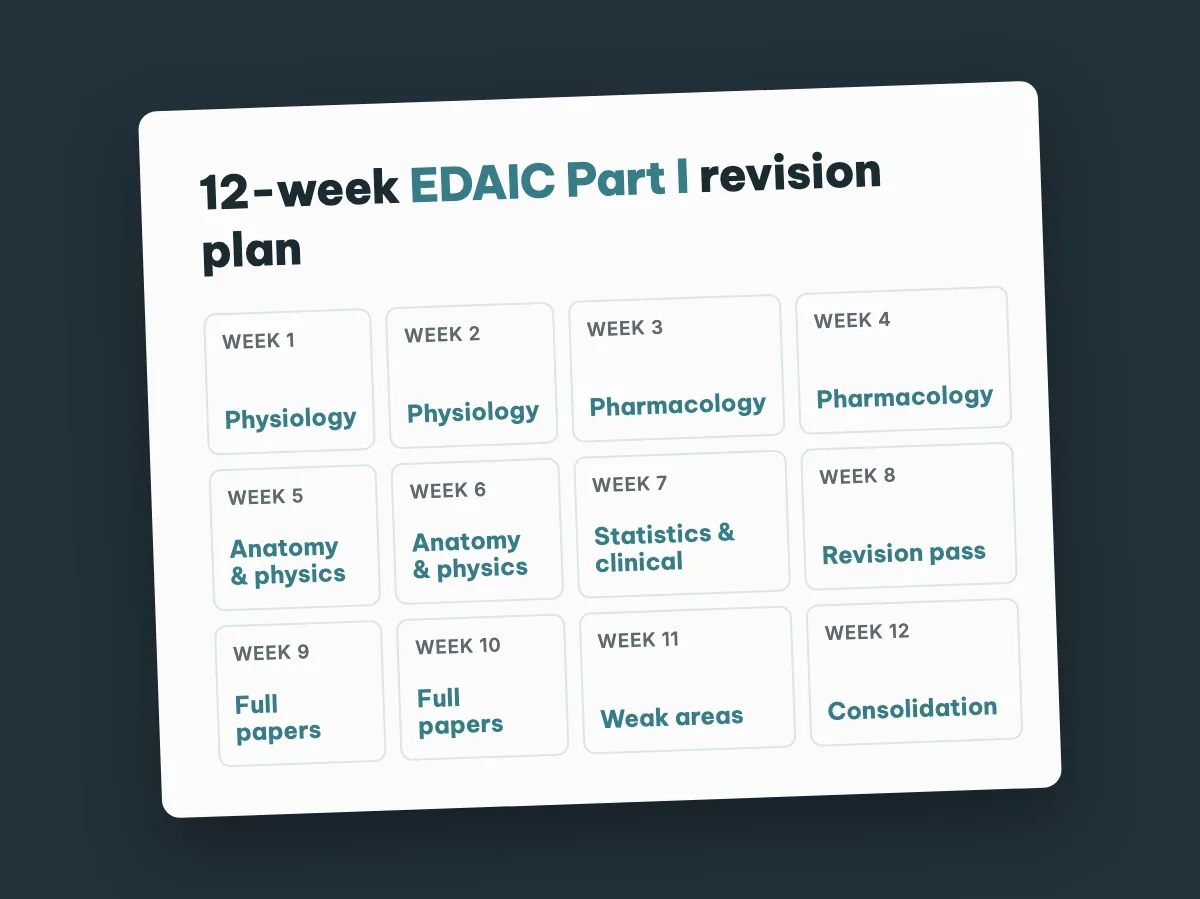
For how to structure the weeks of preparation leading up to the September sitting, see our 12-week EDAIC Part I study plan. For the full breakdown of what each domain actually covers, see our EDAIC Part I Syllabus post.