How to Build a 12-Week EDAIC Part I Study Plan That Actually Covers the Whole Syllabus
Most candidates preparing for the EDAIC Part I start in one of two ways: they open a textbook and begin reading, or they open a question bank and begin answering. Both, taken alone, are wrong.
Reading without testing is passive. You feel like you are learning; you are not retaining. Answering questions without underlying knowledge is guesswork — it produces a score that tells you nothing useful about what you actually know.
A 12-week plan integrates both. Here is how to build one.
Before Week 1: Map the EDAIC Part I Syllabus
Before you start revising anything, open the ESAIC syllabus and list every subtopic under each of the five domains: anatomy, pharmacology, physiology and biochemistry, physics and principles of measurement, statistics.
For each subtopic, ask one question: could I answer five independent true/false statements on this right now? Rate it: confident / shaky / blank.
This takes two to three hours. It is the most valuable thing you will do in your preparation. Without it, you are revising in the dark — spending time on topics you already know while gaps in the syllabus go untouched until the exam reveals them.
For a full breakdown of what each domain contains, see our EDAIC Part I Syllabus post.
The 12-Week EDAIC Part I Study Plan
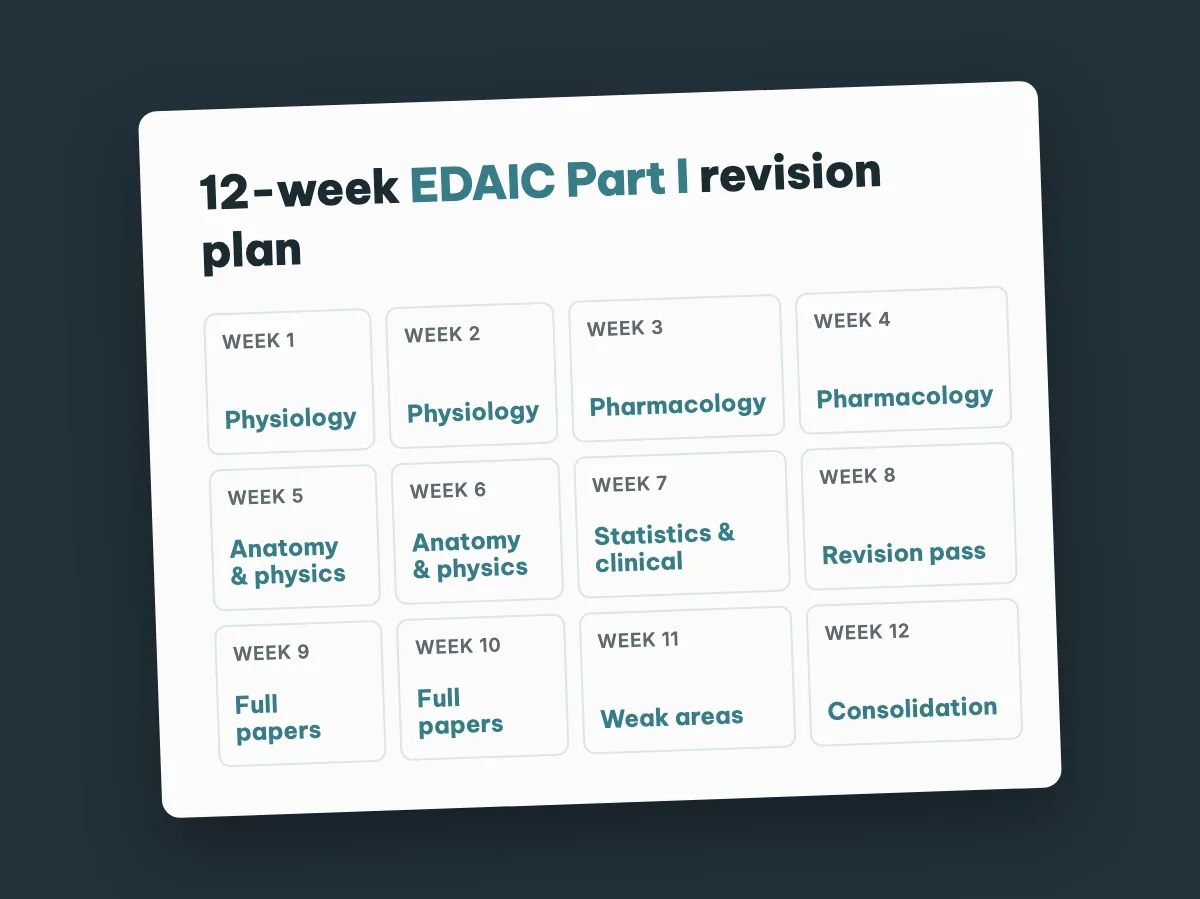
Weeks 1–8: Domain-by-Domain Foundation
Spend roughly 1.5–2 weeks per domain. Work through them in order of examination weight:
- Weeks 1–2: Physiology and biochemistry — the largest domain. Respiratory and cardiovascular physiology tend to feature heavily in Paper A stems.
- Weeks 3–4: Pharmacology — pharmacokinetics, pharmacodynamics, drug toxicity, drugs used in anaesthesia and internal medicine.
- Weeks 5–6: Anatomy alongside physics and measurement. Anatomy is self-limiting once you have covered the key structures; physics and measurement is where most candidates have the largest knowledge gaps.
- Week 7: Statistics, then Paper B clinical extensions — intensive care medicine, obstetric anaesthesia, resuscitation, chronic pain. These build on Paper A content rather than replacing it.
- Week 8: First full revision pass. Return to every subtopic rated “shaky” or “blank” in your Week 0 map. Do not revise what you already know.
For each domain, the structure is the same: read a focused resource, self-test by generating true/false statements from memory, then do 20–30 MTF stems from a question bank on that domain. This is not optional — self-testing is what converts reading into retrievable knowledge.
Weeks 9–10: Full Paper Practice
Move from domain-based revision to full-paper practice. Sit timed papers: 60 stems in 90 minutes at online or CBT centres, or 120 minutes at paper-based centres. Use whichever matches your registered sitting.
Score by domain, not just overall percentage. A 68% overall with a 41% in physics and measurement tells you exactly where the problem is. An overall percentage alone tells you nothing actionable.
Do at least four full papers across these two weeks. Two in week 9, two in week 10. Review every wrong answer by statement — not by question, not by topic. Which specific claim was false? Why? What is the correct version of that claim?
If you want paper practice that mirrors the actual EDAIC format, ThioSuxa EDAIC is built around the five Part I domains with MTF-style questions mapped to the official ESAIC blueprint.
Week 11: Targeted Weak-Domain Revision
Your timed paper scores will reveal two or three specific areas where you are consistently losing marks. Week 11 is for those only.
Do not attempt to revise the entire syllabus again. You do not have time, and the domains you already know will not improve meaningfully in a week. Three weak subtopics fixed properly are worth more than a shallow second pass over everything.
Prioritise ruthlessly. This is the week that determines your margin.
Week 12: Consolidation
No new material. Consolidate what you know.
Light daily question practice — 20–30 stems, untimed — to keep knowledge accessible. Review your highest-error statements from weeks 9–10. Sleep properly. Eat properly. Arrive at the exam rested.
Your performance on exam day will be determined by what you did in weeks 1–11. Week 12 is maintenance, not preparation. Do not start new topics. Do not read a textbook chapter you have never touched before. If you find a gap in week 12, note it and move on — you cannot fix it in three days without destabilising what you already know.
What This Plan Assumes
10–15 hours of active study per week. Below 10 hours, this plan cannot be compressed into 12 weeks — extend it to 16. Above 15 hours consistently, you risk diminishing returns and burnout in the final weeks when it matters most.
A question bank in MTF format. Not adapted SBA questions — EDAIC stems have five independent statements, not a lead-in with five options. The format changes the cognitive skill you are training. ESAIC provides two official mock exams — OLA and HOLA — and a separate quiz tool, EDAIC Trainer; all three use the exact same MTF format.
A focused revision resource per domain, not a full anaesthesia textbook. The ESAIC “How to Prepare for the EDAIC” guide lists recommended reading by domain. Use that list, not whatever textbook is on your shelf.
Starting Late
If you have fewer than 12 weeks, the structure does not change — the compression does.
Cut weeks from the domain phase, not from practice papers. A candidate who has done six full timed papers is consistently better positioned than one who has read every chapter but never sat under time pressure. The exam is a timed retrieval task. You prepare for it by practising timed retrieval.
Eight weeks is workable. Six is tight. Fewer than six, and you need to triage the syllabus aggressively: physiology, pharmacology, and paper practice first. Physics, anatomy, and statistics with whatever time remains.
For the technique you need inside the exam itself — how to evaluate MTF statements, handle borderline questions, and manage the 18-seconds-per-statement pace — see our MTF technique post.