EDAIC Part I Syllabus: What ESAIC Actually Puts in the Exam Blueprint
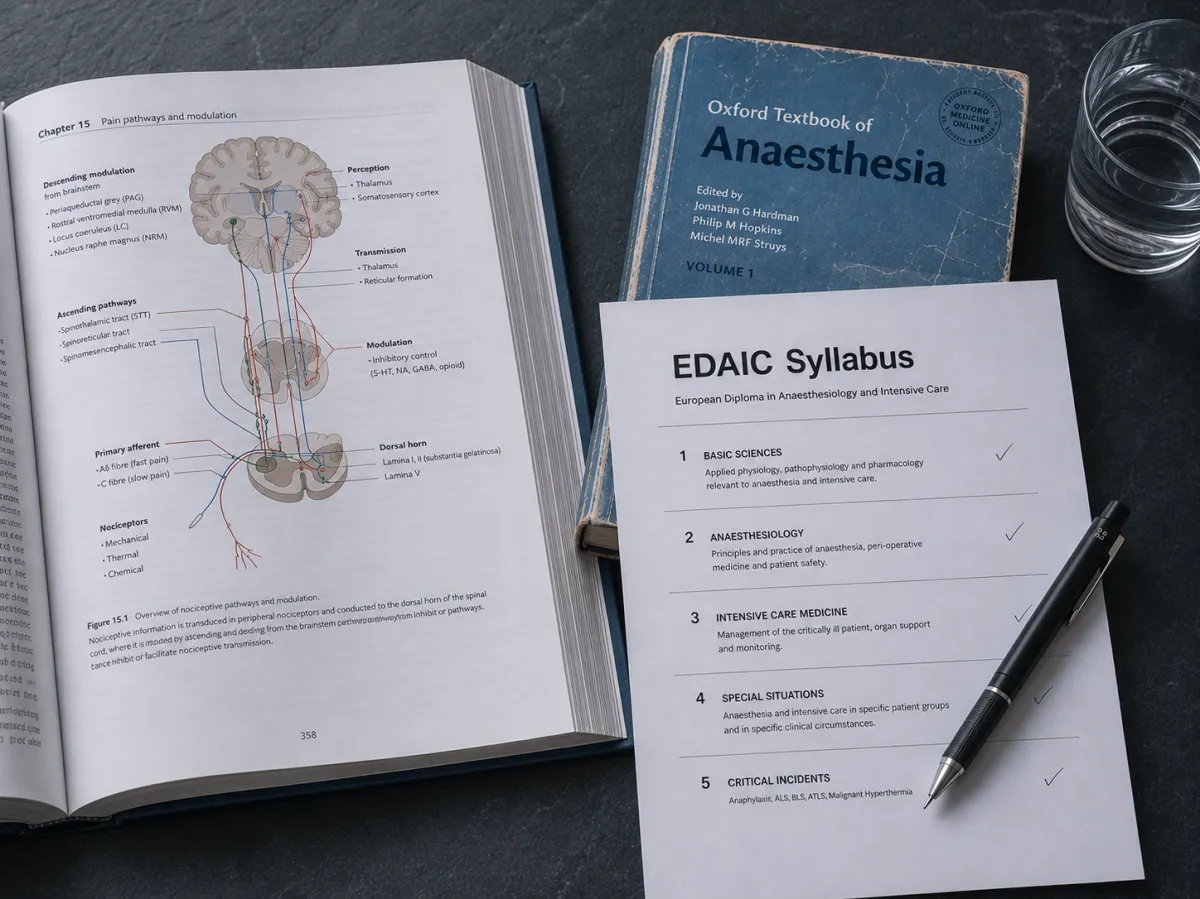
The EDAIC Part I syllabus is published on the ESAIC website. It lists, precisely, what the examination tests. Most candidates have not read it.
The instinct is to go straight to question banks or textbooks. The syllabus sits untouched — even though it is the most accurate map of what you will actually be marked on.
Here is what it says.
Two Papers, One Blueprint
The Part I comprises two written papers: Paper A (basic sciences) and Paper B (clinical anaesthesia and intensive care medicine). Each has 60 MTF question stems — multiple true/false format, meaning each stem has five independent true/false statements. Both papers must be passed individually.
Paper B is not a separate syllabus. It assumes the entire Paper A content and extends it into clinical application. You cannot revise Paper B in isolation from Paper A.
The Five Core Domains
ESAIC organises the Part I syllabus into five knowledge domains.
1. Anatomy
Head and neck, thorax, spine, peripheral nervous system, and vascular anatomy. Clinical anatomy — the structures underpinning nerve blocks, airway management, line placement — not anatomy for its own sake.
2. Pharmacology
Pharmacokinetics (what the body does to the drug), pharmacodynamics (what the drug does to the body), drug toxicity, and drugs used in both anaesthesia and internal medicine. One of the larger domains in practice. Receptor pharmacology, concentration-effect relationships, and context-sensitive half-times are all examinable.
3. Physiology and Biochemistry
The largest domain by coverage. Respiratory, cardiovascular, neurological, renal, hepatic, and endocrine physiology. The physiology of pregnancy, paediatric and neonatal physiology, ageing, coagulation, and acid-base balance. Each of these is a major topic in its own right. Paper A tests them as science; Paper B tests their clinical application.
4. Physics and Principles of Measurement
SI units, gas laws, anaesthetic equipment, electrical safety, fire and explosion hazards. The domain most candidates underestimate. ESAIC tests it directly — gas laws, the physics of vaporisers, electrical safety classifications. Not as background. As examinable content.
5. Statistics
A contained domain, but consistently present. Sensitivity, specificity, positive and negative predictive value, confidence intervals, p-values, and study design. Learn these once, properly, and they are yours for life.
What Paper B Adds
Paper B takes the five domains above and adds clinical content:
- Clinical anaesthesiology — including obstetric anaesthesia
- Resuscitation and emergency medicine
- Intensive care medicine
- Chronic pain management
The practical distinction: Paper A asks what happens physiologically when a patient is hypovolaemic. Paper B asks what you would do and why the pharmacology of the drugs you choose matters in that context.
If you want this mapped out systematically — domain by domain, basic science applied to clinical practice — ThioSuxa EDAIC covers the entire Part I syllabus in exactly this structure.
How to Use the EDAIC Part I Syllabus
Take each domain. List the subtopics. For each one, ask: could I answer five true/false statements on this right now?
If the answer is no: that is a gap. Mark it. Revise it. Return to it.
This sounds obvious. It is. But the number of candidates who sit Part I having covered physiology thoroughly while barely touching physics or statistics is significant. The syllabus is not a suggestions list. ESAIC tests everything on it. The question is whether you have covered it systematically or left pockets unvisited.
Two specific things the syllabus helps you do:
- Prioritise by domain size. Physiology and pharmacology together account for a large share of the 120 stems. Physics and statistics are smaller domains — but they cannot be skipped. A few poor stems in an under-revised domain can tip a borderline candidate into a fail.
- Bridge Paper A to Paper B. For each basic science topic you revise, ask what the clinical application is. That bridge is exactly what Paper B tests.
The Language Option — Worth Knowing
The Part I is available in ten languages alongside English: German, French, Spanish, Italian, Russian, Polish, Hungarian, Portuguese, Turkish, and Romanian. English is always provided as a parallel copy.
If English is not your first language, you are entitled to sit in your preferred language. This is ESAIC policy. It is not prominently advertised. Request it at registration — language preference cannot be changed after the deadline. For the 2026 registration date and deadline, see our EDAIC 2026 calendar post.
For the full picture on the Part I — format, pass mark, scoring, and eligibility — see our EDAIC Explained post.