EDAIC Explained: What It Is, How It Works, and How to Actually Pass It
What Is the EDAIC?
The EDAIC — the European Diploma in Anaesthesiology and Intensive Care — is a postgraduate qualification awarded by the European Society of Anaesthesiology and Intensive Care (ESAIC). It is recognised across Europe and, critically for UK trainees, is accepted by the GMC as evidence of specialist knowledge for the purposes of registration. If you are an international medical graduate working towards a Certificate of Eligibility for Specialist Registration (CESR), the EDAIC is one of the most practical routes available to you.
Beyond the regulatory utility, passing the EDAIC is a genuine marker of anaesthetic competence. The exam is sat by trainees from over 40 countries across four continents, and the standard is serious. It is not a soft alternative to the FRCA — it is a rigorous, well-constructed examination that rewards trainees who prepare intelligently.
EDAIC Structure: Part I and Part II
The EDAIC is a two-part examination. Understanding the format of each part is non-negotiable before you begin any preparation.
EDAIC Part I — The Written Papers
Part I consists of two written papers: Paper A (basic sciences) and Paper B (clinical anaesthesia and intensive care medicine). Each paper has 60 question stems — giving 120 stems in total. The format is Multiple True/False (MTF): each stem is followed by five statements, and every statement is independently marked true or false. That is 600 individual true/false judgements across the two papers.
There is no negative marking. Answer every statement — a blank costs you the same as a wrong answer.
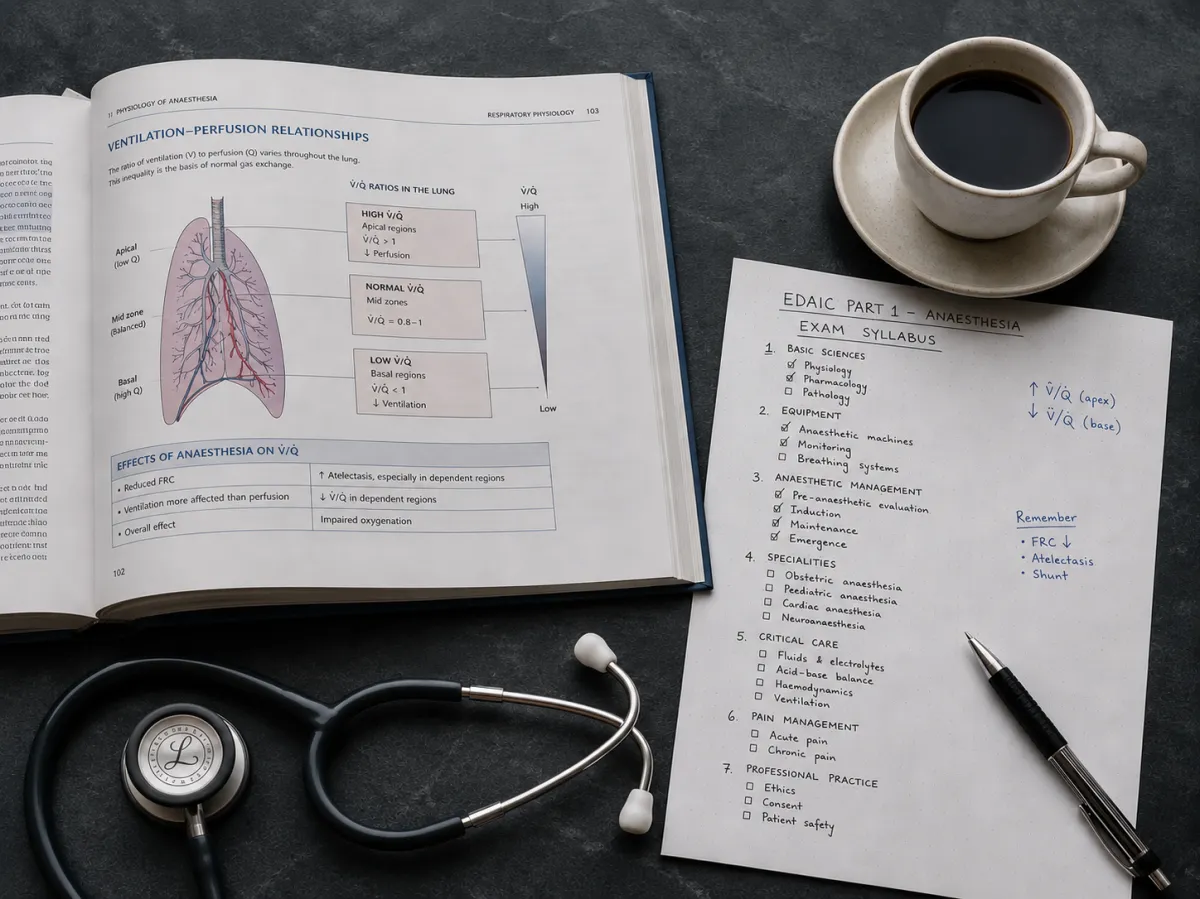
The exam runs once a year, in mid-September, simultaneously at accredited centres worldwide. The syllabus is mapped to the ESAIC’s European Training Requirements (ETR) for anaesthesiology. The subject areas include:
- Basic sciences — anatomy, physiology and biochemistry, pharmacology, physics and clinical measurement, statistics
- Clinical anaesthesia — regional techniques, airway management, obstetrics, paediatrics, neuroanaesthesia, cardiac anaesthesia
- Intensive care medicine
- Pain medicine
- Resuscitation and emergency medicine
The weighting between basic science and clinical content is roughly equal, which distinguishes the EDAIC Part I from the Primary FRCA MCQ, which leans more heavily on basic science. If you have already sat the Primary FRCA, you will find some of the clinical content in EDAIC Part I more straightforward — but do not underestimate the pharmacology and physiology questions. They are written to test application, not recall.
EDAIC Part II — The Oral Examination
Part II is a Structured Oral Examination (SOE) consisting of four SOEs in a single day, each lasting 25 minutes. Two examiners are present per SOE: one questions you for 12.5 minutes, a bell rings, and then the second examiner takes over. You are given a lead-in question or scenario 10 minutes before each SOE to prepare your thoughts.
The four SOEs cover:
- Physiology and anatomy (applied basic science)
- Pharmacology and clinical measurement (applied basic science)
- Clinical anaesthesia and management of critical incidents
- Critical care and emergency medicine, including image interpretation
Part II is held at multiple venues across Europe between February and December each year. In 2026, most sittings were conducted online. You must pass Part I before sitting Part II — and a Part I pass has no expiry date.
Eligibility: Who Can Sit the EDAIC?
For Part I, you can sit at any stage of training — there is no minimum training requirement. For Part II, you must be in the final year of your specialist training programme, or already a fully qualified specialist (required for candidates trained outside Europe). The ESAIC does not grant the full Diploma until you can provide a recognised specialist diploma from your country of work.
For UK trainees, the EDAIC is increasingly relevant at CT2/ST3 level and above. It sits alongside the FRCA rather than replacing it within the UK training structure, but many trainees find that preparing for both simultaneously is efficient given the syllabus overlap.
How the EDAIC Compares to the Primary FRCA
This question comes up constantly, and the honest answer is: they are different exams testing overlapping knowledge. Here is what you actually need to know:
- Syllabus overlap: Both exams test physiology, pharmacology, and clinical measurement. If you are preparing for the Primary FRCA, a significant proportion of that knowledge is directly transferable to EDAIC Part I.
- Question format: The EDAIC Part I uses MTF format — five true/false statements per stem. The Primary FRCA MCQ moved to Single Best Answer (SBA) only in September 2023, removing all MTF questions. These are fundamentally different question styles, and the technique for each is different. MTF rewards systematic knowledge; SBA rewards clinical reasoning and ruling out distractors.
- Oral format: EDAIC Part II SOEs are structured differently from the Primary FRCA SOE. Both reward candidates who can think aloud clearly and handle challenge without crumbling — but the EDAIC orals are broader and the Primary FRCA SOE covers more tightly defined basic science territory.
- Recognition: Within UK training, the FRCA remains the primary qualification. The EDAIC is particularly valuable for CESR applicants and those working or planning to work in Europe.
If you are also preparing for the FRCA, our breakdown of the Primary FRCA covers the MCQ, OSCE, and SOE in full — and our guide to the Final FRCA maps out the Written and SOE for the later stages of training.
If you want this mapped out for you, ThioSuxa EDAIC covers the entire Part I syllabus in exactly this structure — with the MTF technique built into the practice methodology from day one.
Preparing for EDAIC Part I: What Actually Works
The ESAIC publishes sample questions and a preparation guide — use both. Beyond the official resources, here is the preparation framework that experienced candidates recommend:
1. Map the syllabus before you open a textbook
Download the ESAIC curriculum document and the ETR for anaesthesiology. Print them. Use them as a checklist. Trainees who fail Part I most commonly report that they were caught out by topics they simply had not considered — not topics they had studied but forgotten.
2. Practise MTF technique from the start
MTF questions demand a different approach from SBA. You cannot afford to be vague — each statement is independently marked true or false, and there is no partial credit per stem. Build the habit of making a definite true/false call on every statement, every time. Fence-sitting is not an option.
3. Give pharmacology its proper time
Pharmacology is consistently where candidates underperform. The EDAIC tests mechanisms, not trade names. You need to understand receptor pharmacology, drug interactions, and the pharmacokinetics of agents used in anaesthesia and intensive care at a level that allows you to apply principles to unfamiliar scenarios.
4. Do not neglect intensive care
The ICM content in the EDAIC is weighted more heavily than many trainees expect, particularly if they have been working primarily in elective anaesthesia. Cover ventilator modes, sepsis management, renal replacement therapy, and haemodynamic monitoring in genuine depth.
5. Start early and be consistent
The candidates who pass first time almost universally started preparing at least three to four months before the examination. Two hours per day of focused preparation — questions plus review — is more effective than weekend cramming. The volume of material does not compress well.
Preparing for EDAIC Part II: The Oral Examination
The oral examination is where well-prepared candidates still fail — usually because they have not practised speaking under examination conditions. The following are non-negotiable:
- Practise out loud with a partner. Reading notes is not practice. Answering questions verbally, in real time, with someone who will challenge you, is practice.
- Learn to structure your answers. Start with a clear opening statement, then expand. Examiners reward candidates who demonstrate structured thinking, not just knowledge retrieval.
- Use the 10-minute preparation time properly. Before each SOE you get a lead-in question 10 minutes in advance. Candidates who do not practise using this time efficiently waste the single biggest advantage the exam gives you.
- Know your intensive care cold. SOE 4 is dedicated to critical care and emergency medicine, including image interpretation. Candidates with limited ICM exposure need to invest disproportionate preparation time here.
The EDAIC Is Achievable — With the Right Preparation
The content is defined. The format is known. The resources are available. Trainees who fail typically do so because they underestimated the breadth of the syllabus, left preparation too late, relied on passive revision rather than active question practice, or — specifically for Part I — never adapted to the demands of MTF question technique.
The knowledge required to pass this exam is the same knowledge that makes you a safer, more capable anaesthetist. That is the right framing to carry through your preparation.
Ready to pass the EDAIC?
ThioSuxa EDAIC covers every syllabus domain for Part I — with MTF question technique, timed practice papers, and a structured study plan built around the September sitting.