The Primary FRCA Has Three Parts — Most Trainees Only Prepare for One
Most trainees preparing for the Primary FRCA think of it as one thing. A bank of questions. A block of revision. One hurdle.
It is not one thing. It is three separate examinations — each with a different format, a different skill being tested, and a different way of failing you. Understanding that distinction is not a minor detail. It is the difference between a structured preparation and a very expensive surprise.
Here is exactly what the Primary FRCA looks like, part by part.
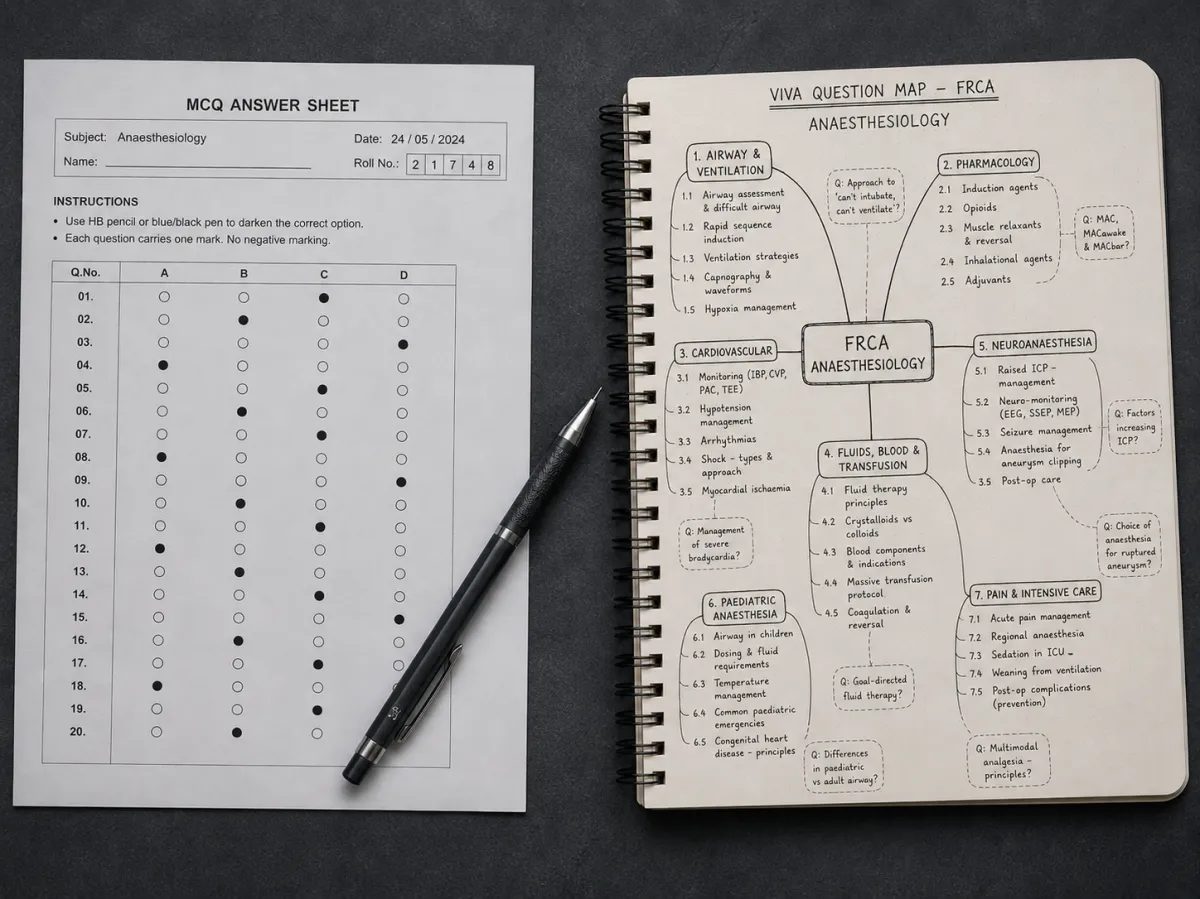
Part One: The MCQ — 90 Questions, 3 Hours, No Negative Marking
The MCQ is the gateway. You cannot sit the OSCE or the SOE until you have passed it.
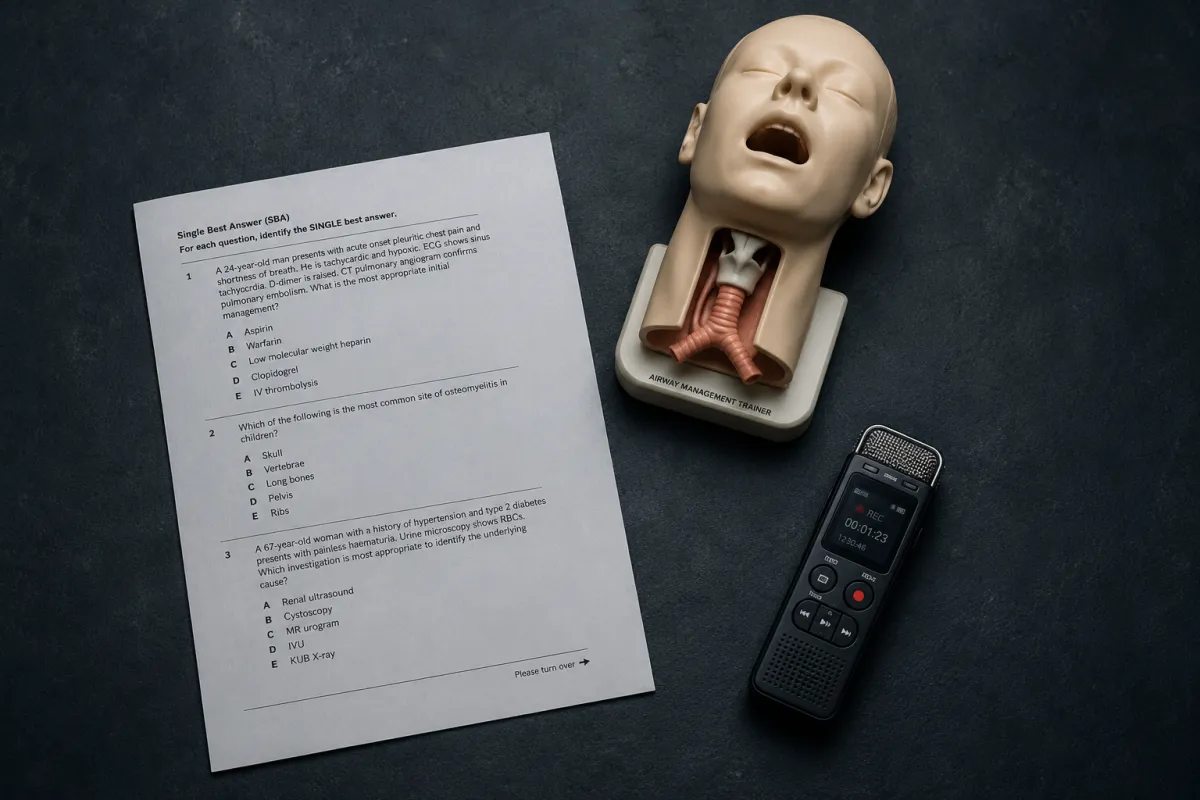
Since September 2023, the Primary FRCA MCQ uses only Single Best Answer (SBA) questions — the old Multiple True/False (MTF) format, where you judged each of five statements independently as true or false, has been removed entirely. Every question now gives you a clinical stem or vignette, a lead-in question, and five options. You pick one. The single best answer.
Ninety questions. Three hours. One mark per correct answer. No penalty for a wrong answer — which means you should never leave a question blank.
The pass mark is not fixed. It is set before each sitting using a method called modified Angoff standard-setting: a panel of examiners independently estimates what a borderline-competent candidate should score on each question, and those estimates are averaged to produce the cut-off. From February 2025, the College stopped applying an additional downward adjustment to this cut-off, so the mark you need is now the raw Angoff-derived figure. It varies by sitting.
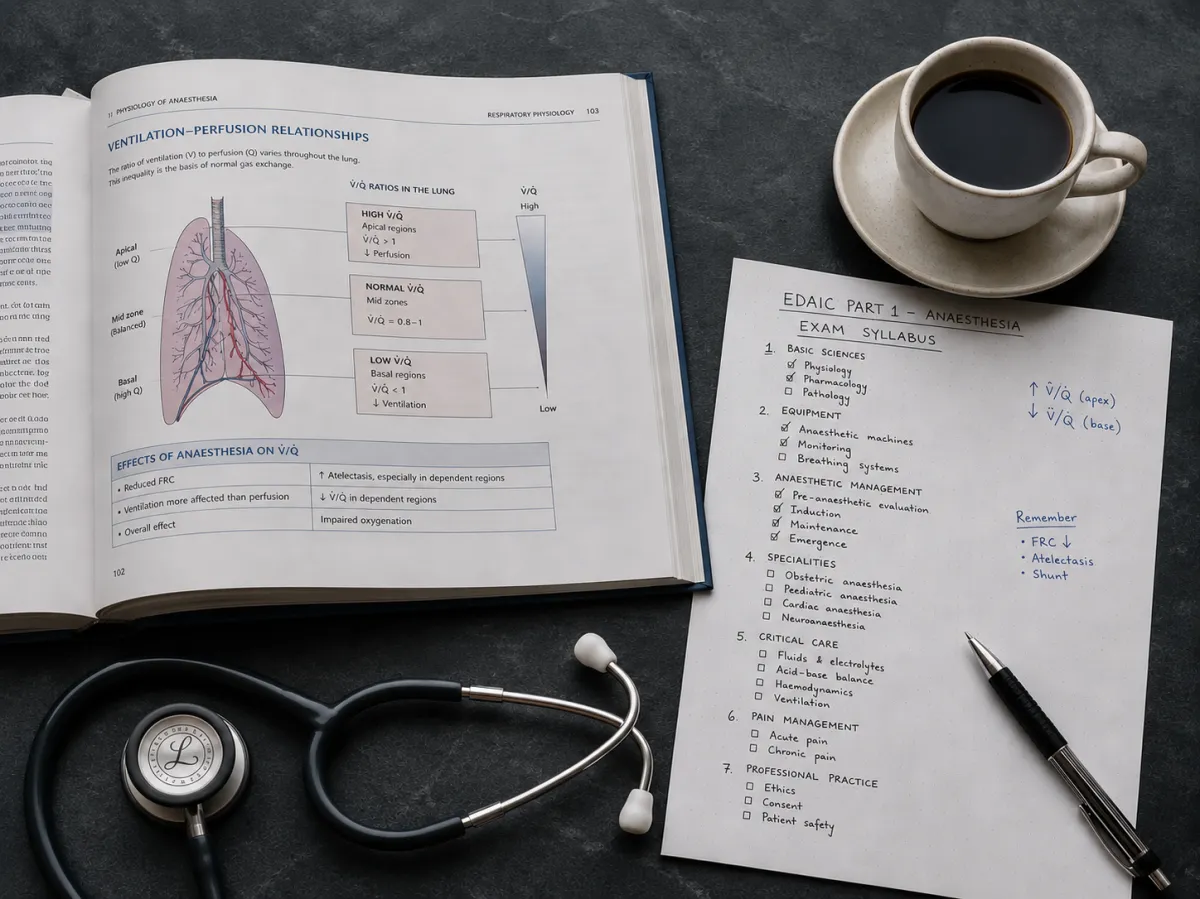
The syllabus maps to Stage 1 of the UK anaesthetic training curriculum — the core level — and is weighted heavily towards physiology, pharmacology, and physics and clinical measurement. These are not peripheral topics. They are the exam.
You have a maximum of six attempts across the entire Primary FRCA. A pass in the MCQ is valid for three years — meaning you must complete the OSCE and SOE within that window or resit the MCQ.
Three sittings run each academic year, typically in September, November, and February, delivered online with remote invigilation.
Part Two: The OSCE — Up to 16 Stations, 5 Minutes Each
The Objective Structured Clinical Examination (OSCE) is where the preparation for most trainees visibly thins out. You cannot pass the Primary FRCA on question banks alone.
The OSCE circuit contains up to 16 live stations, each lasting five minutes. Before each station, you get one minute to read the guidance outside the door. Then the bell rings and you go in.
What happens inside varies. An examiner may place a piece of equipment in front of you and ask you to explain it. You may be asked to demonstrate a technical skill. You may interact with a simulated patient — an actor — and be expected to take a focused pre-operative history, explain a procedure, or obtain consent under time pressure. Clinical data interpretation, anatomy questions, equipment checks — it all appears here.
Each station is marked out of 20. The pass mark for each station is set pre-exam by examiners using the same modified Angoff method, and the station pass marks are summed to produce the overall cut-off for the circuit. There is no negative marking.
The OSCE is held in person at the Royal College of Anaesthetists, three times per academic year. On your first attempt, you must sit the OSCE and SOE together. If you pass one and fail the other, you only resit the component you failed — but the three-year validity clock from your MCQ pass keeps ticking.
Part Three: The SOE — 12 Questions, 60 Minutes, Two Examiners Watching
The Structured Oral Examination (SOE) is the part that frightens trainees most. It should not — if you have understood what it actually tests.
There are two parts to the Primary SOE, each lasting 30 minutes.
SOE 1 covers basic sciences: three questions on pharmacology and three questions on physiology and biochemistry. SOE 2 covers clinical topics — including a critical incident question — and three questions on physics, clinical measurement, equipment, and safety.
Twelve questions in total. Four examiners in total — two per part — each marking independently. Each question is scored 2 (pass), 1 (borderline), or 0 (fail) by each examiner. That gives a maximum of 48 marks: 12 questions × 2 examiners × maximum 2 marks each.
The pass mark is fixed at 37 out of 48 — set by the RCoA Examinations Committee based on historical data, calibrated to produce a pass rate of 50–55%. It does not vary by sitting. You are told pass or fail, not your score.
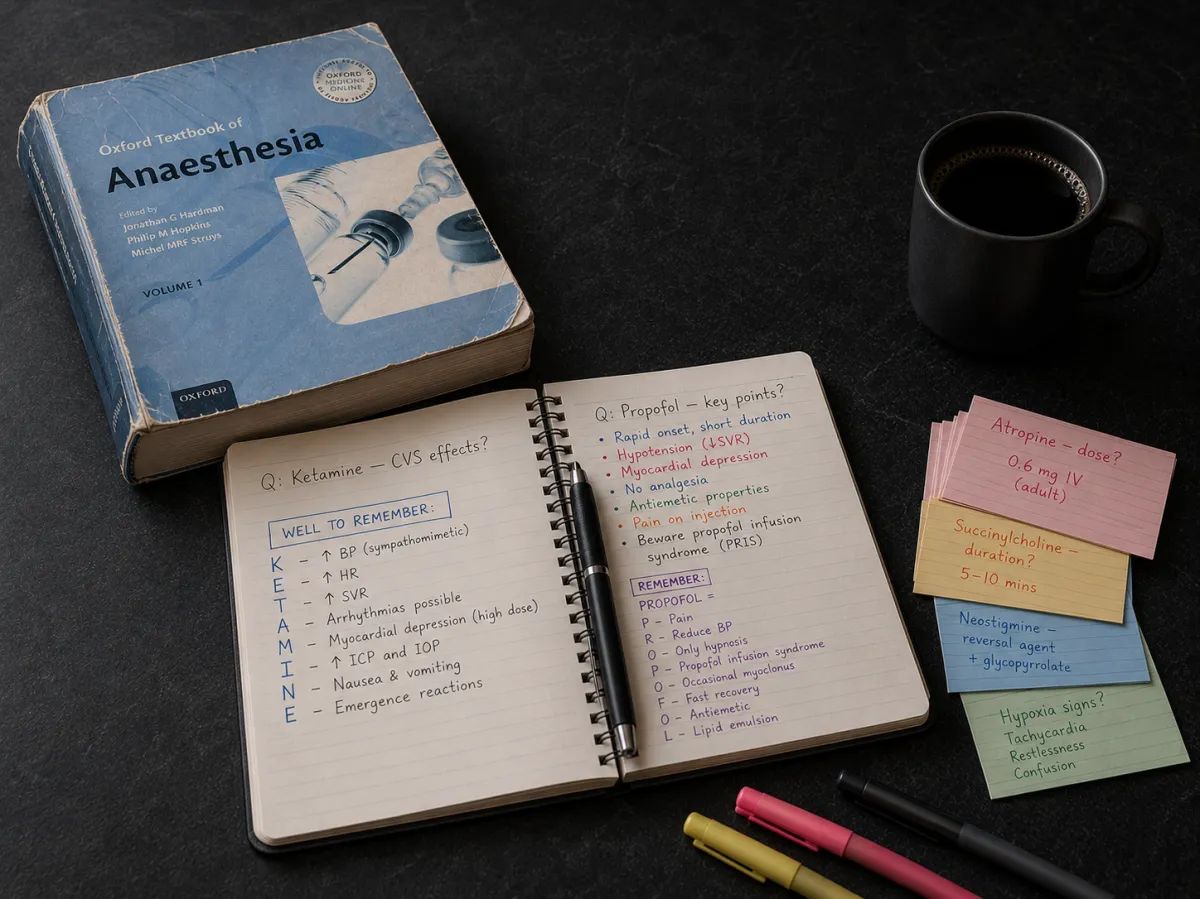
What the SOE is actually testing is not recall. It is your ability to think out loud, in real time, in the language of anaesthesia science. A candidate who has memorised facts but cannot build a coherent answer under pressure will struggle here. A candidate who understands mechanisms — why a drug behaves the way it does, what the physiological consequence actually is — will find it far more manageable.
Rhetorical question you are probably asking: How is the SOE different from just knowing the MCQ answers?
Here is the difference. In the MCQ, you recognise the right answer. In the SOE, you construct it. The examiner can follow up. They can redirect you. They can ask you to go deeper. Recognition and construction are not the same cognitive skill, and they require different preparation.
The Sequence Matters
MCQ first. Then OSCE and SOE together. That is the mandated order.
A pass in the entire Primary FRCA is valid for seven years towards your eligibility for the Final FRCA. When you are ready to look ahead, our guide to the Final FRCA maps out the Written and SOE — they test at a very different level from the Primary. But the individual components have shorter windows — your MCQ pass gives you three years to complete the rest of the Primary. Plan accordingly.
Non-UK trainees can sit the Primary FRCA by applying for International Affiliate membership of the College. The former Temporary Examination Eligibility route no longer exists. The College recommends completing the Initial Assessment of Competency before your first attempt — check the current RCoA guidance for what this means for your training stage.
What Most Trainees Get Wrong
They over-index on the MCQ and under-prepare for the SOE.
Why? Because question banks are measurable. You can do 50 questions today, review your score, and feel productive. Viva practice requires another person, a willingness to be corrected out loud, and a tolerance for feeling stupid in front of a colleague. Most trainees avoid it until the last few weeks.
That is too late.
The SOE rewards candidates who have been verbalising their knowledge for months, not days. Physiology and pharmacology that lives only in your notes will not flow when an examiner is sitting across from you and the clock is running.
Start viva practice before you feel ready. That discomfort is the preparation.
If you want the EDAIC Part I syllabus — which overlaps substantially with the Primary FRCA basic sciences — mapped out and taught in a structured format, see our full EDAIC guide. ThioSuxa EDAIC covers physiology, pharmacology, and clinical measurement in this depth, so it can sit alongside your Primary FRCA preparation.
One Final Thing
The Primary FRCA is hard. Not because the knowledge is obscure — the syllabus is defined, the domains are known, and the question formats are published. It is hard because most trainees prepare for one exam and sit three.
Treat the MCQ, the OSCE, and the SOE as three separate preparation problems. Allocate time to each deliberately. Do not let the measurability of question banks seduce you into ignoring the skills that only come from deliberate clinical practice and structured viva work.
Know the format. Plan for all three parts. Then prepare accordingly.
One thing worth knowing for the longer term: the RCoA has confirmed that the current Primary FRCA structure is changing from July 2027. The MCQ will be replaced by a new Applied Knowledge Test (AKT), and both the OSCE and SOE will be replaced by a new Clinical and Anaesthetic Sciences Exam (CASE) — a circuit of 13 stations of 9 minutes each, using role players and simulation to assess clinical performance. July 2027 to June 2028 is a transition year: candidates with existing partial passes can still complete the current components, but all first-time candidates from July 2027 will sit the new format. If you are sitting before July 2027, the format described in this post applies in full. Check the RCoA 2027 launch page for the latest transition guidance.
Ready to pass the EDAIC?
If the basic sciences — physiology, pharmacology, physics — are the core of both the Primary FRCA and the EDAIC, there is no reason to prepare for them twice from scratch. ThioSuxa EDAIC teaches the same foundations in a structured, exam-focused format built specifically for anaesthesia trainees.