The Final FRCA: What It Actually Tests and How to Approach It
The Final FRCA Is Not the Primary FRCA, Just Harder
That is the most common mistake trainees make. They assume the Final is the same exam — same structure, same style, just with more difficult content piled on top. It is not.
The Final FRCA is two separate examinations — a Written component and a Structured Oral Examination (SOE) — each testing a distinct kind of competence, each with its own pass/fail logic, and each perfectly capable of failing you independently. Understanding that distinction changes how you prepare.
Here is what the Final FRCA actually consists of, what each part is testing, and how to approach it without wasting the runway.
The Written Examination: Two Papers, One Decision
The Final FRCA Written has two papers, sat on separate days — but they form a single examination. The marks from both papers are added together, and the combined total determines pass or fail. There is no separate pass or fail verdict for each paper.
The MCQ Paper: 90 SBA Questions, 3 Hours
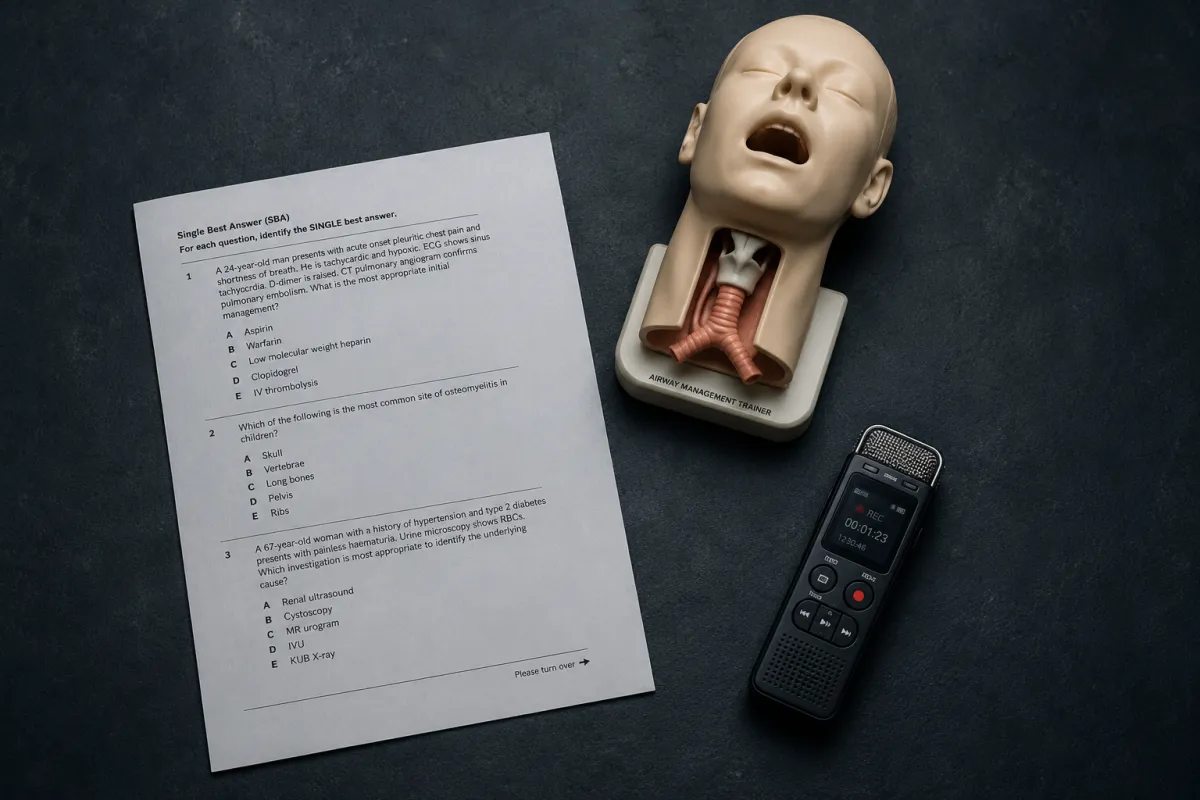
Same format as the Primary MCQ — 90 Single Best Answer questions, clinical vignette, lead-in question, five options, one mark per correct answer, no negative marking. Three hours.
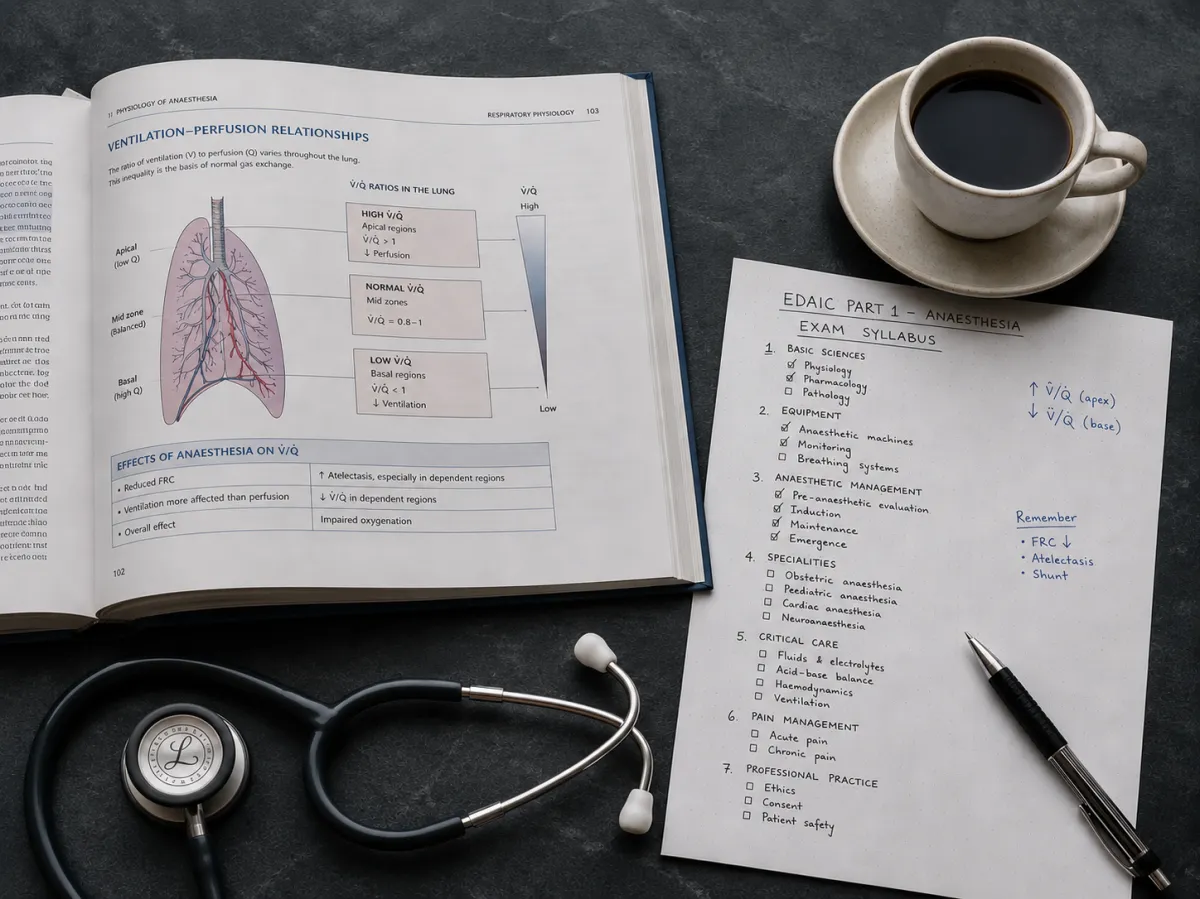
What changes entirely is the content. The Final MCQ maps to the intermediate curriculum — Stages 1 and 2 of anaesthetic training — and the breadth is considerably wider than the Primary. Six mandatory subspecialty units: neurosurgery, neuroradiology, and neuro-critical care; cardiothoracic surgery; intensive care medicine; obstetrics; paediatrics; and pain medicine. Add general duties and advanced sciences on top of that. The clinical vignettes are more complex, the distractors are better constructed, and familiarity alone will not carry you through.
If you found the Primary MCQ manageable, do not use that as a benchmark for how much preparation the Final requires. They are not in the same league.
The pass mark is set using modified Angoff standard-setting — examiners estimate what a borderline-competent candidate should score on each question, and those estimates produce the cut-off. From February 2025, the previous practice of reducing that mark by one Standard Error of Measurement was discontinued. The bar is now exactly where the examiners judge it should be. It varies by sitting. The only reliable response to a variable pass mark is to not be a borderline candidate.
No negative marking. Answer every question.
The MCQ is delivered online with remote invigilation, twice per academic year — typically September and February/March.
The CRQ Paper: 12 Questions, 3 Hours, Technique Is Everything
The Constructed Response Question (CRQ) paper is where the Final catches trainees who have only prepared for the MCQ format.
Twelve compulsory questions. Three hours. Structured written responses. Think: “List four causes of X”, “Outline your management of Y in the first hour”, “Give two mechanisms by which Z occurs.” Only the first distinct answer per line is marked — write the same point twice in different words, and you score zero for the second line. Bury the right answer inside a prose paragraph, and the examiner is under no obligation to hunt for it. Precision and structure are everything.
Each question is marked out of 20 by examiners working in pairs — six examiners across one paper, two questions each. The pass mark for each question is set pre-exam using modified Angoff, and those 12 question pass marks are summed to set the overall paper cut-off.
CRQ technique is a learnable skill. But it requires specific practice: writing structured responses, under timed conditions, in the exact format the mark scheme rewards. Passive reading and mental rehearsal do not develop it. Writing does. Start writing practice answers earlier than feels necessary.
The CRQ paper is also sat online, twice per academic year, on a separate day from the MCQ.
A pass in the Final Written is valid for three years towards the Final SOE. Do not pass the Written and then delay.
The Final SOE: Where the Fellowship Is Actually Decided
Pass the Written, and you sit the Final SOE. Pass the SOE, and you are a Fellow of the Royal College of Anaesthetists.
Simple to state. Harder to earn.
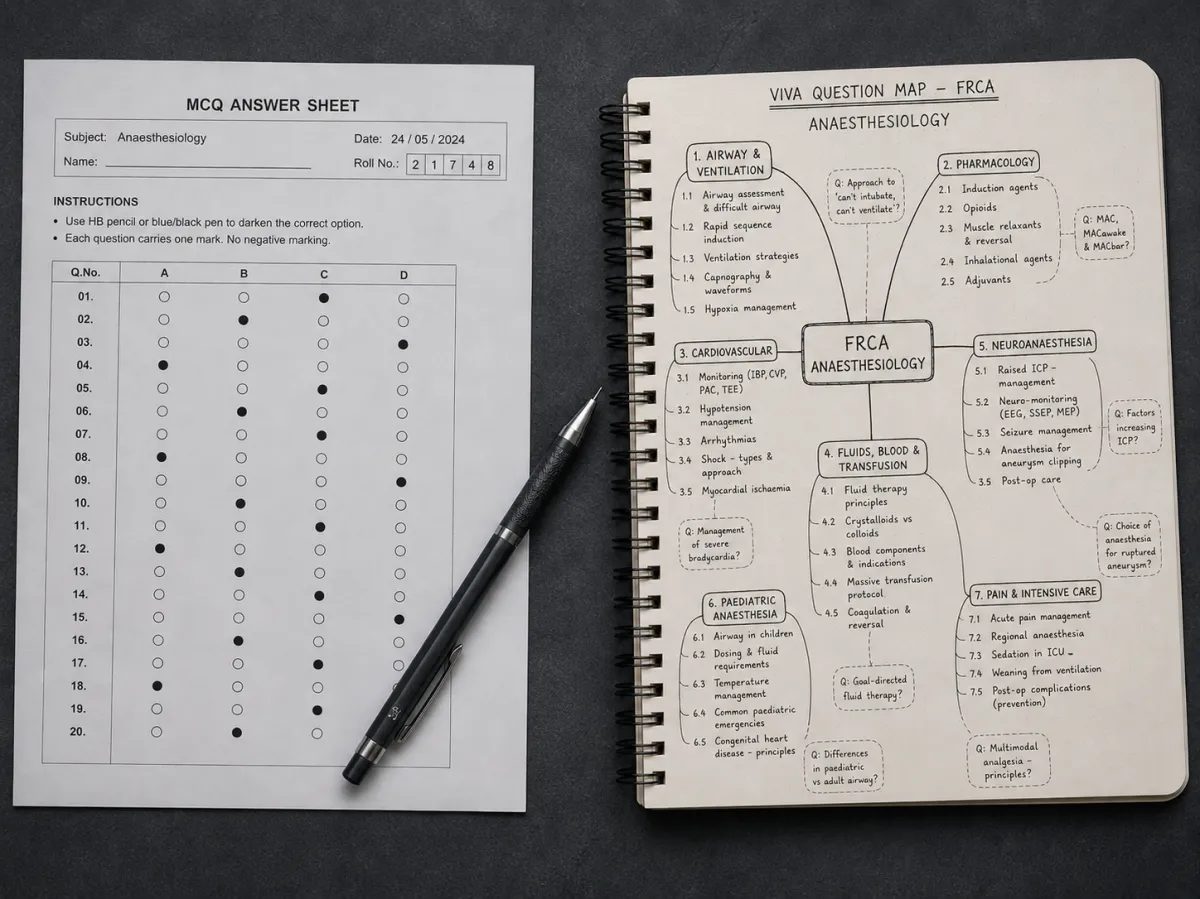
The Final SOE has three parts: SOE 1A, SOE 1B, and SOE 2 — all sat in a single day.
SOE 1A and SOE 1B — 26 Minutes Each
Each part follows the same structure: two clinical short cases, each paired with a linked clinical science question. The science question may come before or after its short case — the order is not fixed. Two examiners are present throughout each part.
Twenty-six minutes per part. That is not much time. Candidates who wander in their answers, hedge excessively, or cannot produce a clear opening statement under pressure will feel every second of it.
SOE 2 — 36 Minutes
Ten minutes before SOE 2 begins, you are given clinical material to review — imaging, blood results, monitoring data, a clinical scenario. This is preparation time. Use it properly: form a structured differential, anticipate where the questioning will go, identify what you know and what you are less confident on. Candidates who treat those ten minutes as a formality and try to improvise in the room are at a serious disadvantage.
SOE 2 itself has two sections: a two-part clinical long case based on the material you reviewed (13 minutes), followed by two stand-alone clinical short cases unrelated to the long case (13 minutes).
The Numbers That Matter
12 sections across all three parts. 88 minutes of examination time in total. Eight examiners — two per subsection, each marking independently. Every section scored 2 (pass), 1 (borderline), or 0 (fail). Maximum 48 marks across the whole SOE.
And the rule that trips people: all sections must be passed. A strong SOE 1 cannot rescue a failed SOE 2. The exam does not average across parts.
The pass mark is set using the Borderline Regression Method — a candidate-centred approach where the pass mark adjusts slightly with each cohort based on examiner judgements. There is no fixed number. The only safe strategy is to perform genuinely well across every section.
If you want the applied basic science foundation — physiology, pharmacology, clinical measurement — that underpins both the Written and SOE, structured and taught in exam-relevant depth, ThioSuxa EDAIC covers that ground alongside the EDAIC curriculum, which makes it useful during Final FRCA preparation too.
The Final SOE is held in person, typically twice per academic year.
What the Final FRCA Is Actually Testing
Strip away the formats and both components are asking one question: Can you function at the level of an independent consultant anaesthetist?
The Written tests whether your knowledge spans the full subspecialty curriculum and whether you can discriminate and communicate under pressure — picking the single best option from five plausible ones, or producing a precisely structured written response in limited time. The SOE tests whether you can reason clinically out loud, across complex scenarios, with examiners who will follow up, redirect, and push.
Recognition is not the same as construction. In the MCQ, you identify the right answer. In the SOE, you build it in real time and defend it. These are different cognitive skills, and they require different kinds of preparation.
That means practice questions alone are not enough. You need to have written CRQ-format responses under timed conditions, many times. You need to have spoken your clinical reasoning aloud — not summarised it mentally — for months before the SOE.
Eligibility, Sequencing, and the Non-UK Rule
You must have passed the Primary FRCA before sitting the Final Written. If you are still working through the Primary, our breakdown of all three Primary FRCA components covers the MCQ, OSCE, and SOE in detail. A pass in the Primary is valid for seven years towards Final FRCA eligibility — that sounds like a long runway, but the subspecialty breadth and the verbal preparation the SOE demands both take more time to build than most trainees expect. Start earlier than feels necessary.
Non-UK trainees have an additional requirement for both the Written and the SOE: you must have been employed in a UK NHS anaesthetic post for at least 12 continuous months immediately before the exam date. This applies at both stages. Plan your timeline around it.
Maximum six attempts per section. Check the current RCoA eligibility guidance and examination calendar for fees and dates — both are updated annually.
The Subspecialties Are Not Optional
The Primary FRCA is broad but defined — physiology, pharmacology, physics, clinical measurement. The Final adds six mandatory subspecialty units on top: neurosurgery/neuroradiology/neuro-critical care, cardiothoracic surgery, intensive care medicine, obstetrics, paediatrics, and pain medicine.
Trainees who struggle with the Final are not usually weak on the basic sciences. They are the ones who underestimated the subspecialties — particularly ICM, weighted heavily across both Written and SOE, and paediatrics, which many trainees have had limited clinical exposure to.
Map the six mandatory units against your clinical experience. Identify the gaps honestly. Then prepare for those gaps disproportionately.
The exam does not care which subspecialties you enjoyed as a trainee.
If you are also sitting the EDAIC — the European diploma with significant syllabus overlap — our EDAIC guide covers the MTF format, Part II structure, and preparation strategy in full.
The Final FRCA Is Also Changing — From July 2027
The RCoA has confirmed that the Final SOE will be replaced from July 2027 by a new Final Clinical Performance Exam (FCPE) — a station-based circuit format, similar in philosophy to the new Primary CASE exam. The Final Written examination (MCQ and CRQ) is expected to continue in its current form. July 2027 to June 2028 is a transition year: candidates with partial passes can still complete the current SOE, but all first-time Final FRCA candidates from July 2027 will sit the FCPE. If you are sitting the Final SOE before July 2027, the format described in this post applies in full. Check the RCoA 2027 launch page for current guidance.
Ready to pass the EDAIC?
The applied basic sciences at the core of the Final FRCA — physiology, pharmacology, physics, and clinical measurement — are exactly what ThioSuxa EDAIC teaches, in a structured, exam-focused format built for anaesthesia trainees preparing for high-stakes postgraduate examinations.