EDAIC Part II in 2026: The Online Format, What the Regulations Say, and What to Do on Exam Day
Published May 2026. Dates and fees are for the 2026 cycle — check ESAIC for current information.
Most candidates know the EDAIC Part II is an oral examination. Fewer have read the regulations that govern how it actually runs — especially for online candidates, which in 2026 is the majority.
ESAIC publishes the full Candidate Agreement before each exam cycle. Here is what the 2026 document says, section by section.
Online or Face-to-Face: The 2026 Split
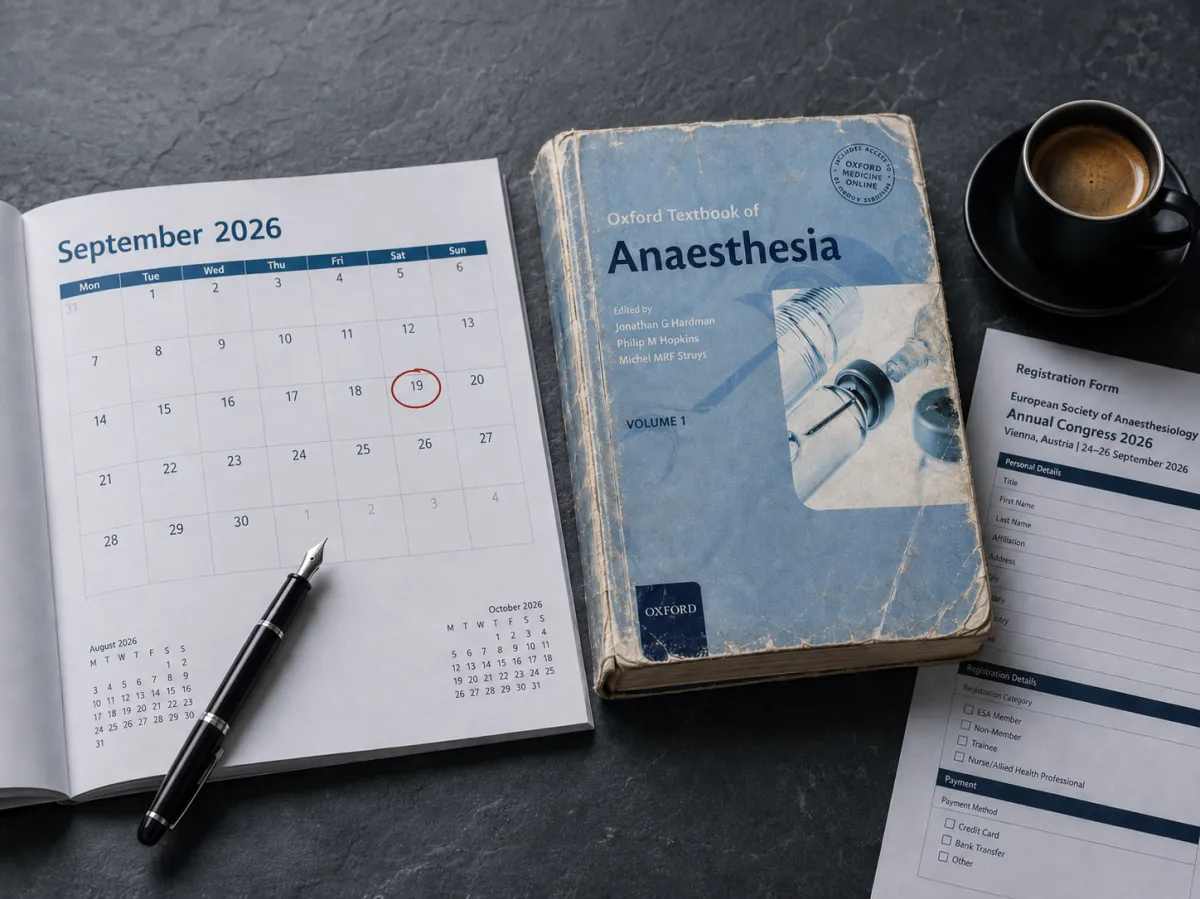
The Part II in 2026 runs at seven face-to-face centres — Ankara, Porto, Uppsala, Frankfurt, Erlangen, Istanbul, and Cairo — with specific two-day windows at each. All remaining sessions are online.
| Centre | Dates |
|---|---|
| Ankara | 11–12 April 2026 |
| Porto | 17–18 April 2026 |
| Uppsala | 19–20 May 2026 |
| Frankfurt | 27–28 June 2026 |
| Erlangen | 25–26 September 2026 |
| Istanbul | 3–4 October 2026 |
| Cairo | 31 October–1 November 2026 |
The arrangement at Ankara and Uppsala is specific: candidates are physically present at those centres, but examiners connect remotely. For all other online sessions, both candidate and examiners connect from their respective locations.
The format is identical regardless of delivery mode: four Structured Oral Examinations (SOEs) in a single day, 25 minutes each, with two examiners per SOE. Morning sessions cover applied basic sciences (SOE 1: physiology and anatomy; SOE 2: pharmacology and clinical measurement); afternoon sessions cover clinical practice (SOE 3: clinical anaesthesia and critical incidents; SOE 4: critical care, emergency medicine, and image interpretation). Ten minutes of preparation time before each SOE.
Equipment: What ESAIC Requires for the Online Exam
Section IV of the Candidate Agreement lists the equipment requirements. These are not suggestions.
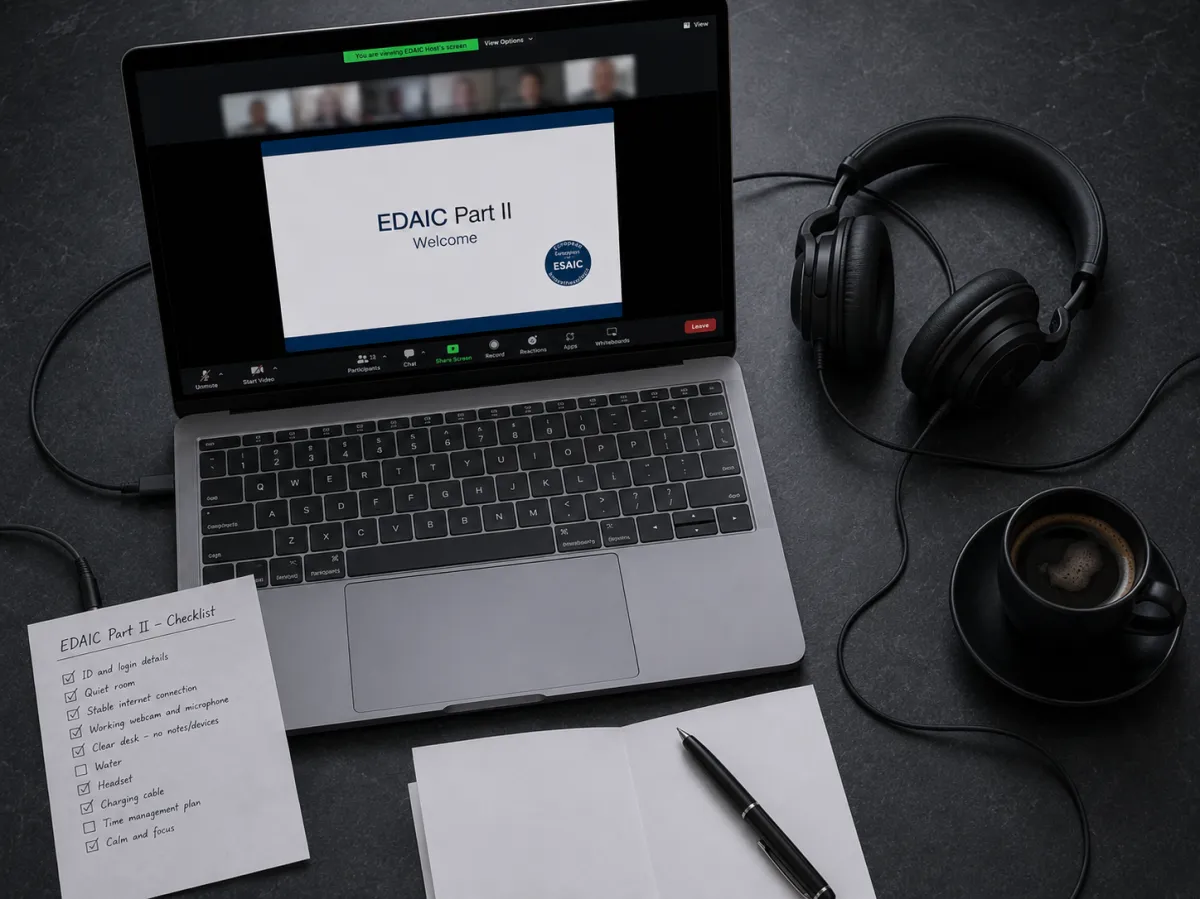
- A laptop with integrated webcam. Tablets and smartphones are not allowed. A desktop with a separate webcam is also acceptable.
- A wired internet connection (or stable WiFi). ESAIC recommends testing using fast.com several weeks before the exam. The minimum recommended speed is 10–20 Mbps for a stable Zoom experience.
- A wired headset with microphone. Bluetooth devices are not recommended. The computer’s built-in speaker and microphone are not allowed — you must use an external wired headset.
- Zoom — downloaded and installed on the examination laptop, with an account created using the same email address as your MyESAIC account.
- White paper and a standard black pen.
- Good lighting — the main light source should not be behind or beside you. The camera distance should show your full face and upper chest, as on an ID photograph.
If you want your Part I preparation sorted before the oral stage — ThioSuxa EDAIC covers the full Part I syllabus, the exact content the SOE 1 and SOE 2 examiners draw on in the morning sessions.
EDAIC Part II Candidate Regulations: What the Agreement Actually Says
The online and face-to-face rules differ in important ways. Here is what the online section specifies.
The 30-Minute Rule
Online candidates must be in front of their computer at least 30 minutes before the start of each of their four sessions. ESAIC staff conduct security checks before the preparation period for each SOE. Thirty minutes. For each of the four sessions. Plan your day accordingly.
Devices
The online rule is different from the face-to-face rule — and it catches candidates off guard.
For the online exam, mobile phones and other remote communication devices must be placed out of your reach, preferably in a different room. The trigger for termination is having the device within reach. But here is the important part: your mobile phone must remain switched on (on vibrate or mute) throughout the day. ESAIC staff may need to contact you. You agree to show your phone to staff when prompted.
Do not switch it off. Do not leave it in another building. Place it out of reach in the same space, or in an adjacent room — on, and available to show on request.
Desk and Room Setup
The only items permitted on the examination table: laptop or desktop with webcam, a mouse, blank paper, a couple of standard pens, and a glass of water. The table and immediate surroundings must be clear of everything else. All doors must be closed. No one else may enter the room during the examination.
Security Checks
Before each session, you agree to:
- Show your examination room via your webcam to ESAIC staff
- Show your mobile phone to ESAIC staff when prompted
- Show your paper and pen before starting
- Share your computer screen and give remote control via Zoom’s “give control” feature when requested by staff or examiners
Anonymity
The EDAIC Part II is anonymous. You identify yourself with your candidate number only — never your name, and never any mention of your hospital. This applies to all communication with examiners and with the examination Host throughout the day.
Notes
The preparation notes you make before each SOE must be torn and discarded immediately after each oral session — not saved, not kept until the end of the day.
Independence
No communication with any other person during preparation or examination time. No notes, textbooks, digital resources, or AI tools. Any outside source of knowledge — physical or digital — is forbidden. Immediate disqualification.
Connection Drop: The 5-Minute Rule
If your connection is lost — or if the quality of your connection or headset does not allow the exam to proceed properly — for more than 5 minutes while being examined by examiners, your examination will be terminated. ESAIC cannot be held responsible.
Five minutes is not much. The document is emphatic about this. Test your setup weeks before, not the morning of. Have a contingency ready — a mobile hotspot, a second connection option. A stable 10–20 Mbps connection is the minimum; more headroom is better.
Non-Compliance
Failure to abide by the Candidate Agreement can result in:
- Termination of your examination at your own expense
- A two-year exclusion from all EDAIC examinations and assessments
- Legal action where relevant
These are not boilerplate warnings. They are the enforcement mechanism for a high-stakes professional examination.
The 2026 Registration Window — and What It Means for 2027
The 2026 Part II registration deadline was 2 February 2026. All sessions are now full. For the full 2026 fee structure for both parts, see our EDAIC 2026 calendar post.
If you are planning for Part II in 2027, watch the ESAIC Part II page from late 2026. Registration for early-year sessions will open several months in advance. Online sessions in English tend to fill fastest. Early registration matters — for specific language sessions or early-year dates, seats are limited.
Check the official page directly: esaic.org/professional-growth/edaic/part-ii-examination. Do not rely on third-party calendars for registration dates.
For a full overview of the Part II — how the four SOEs are structured, how marking works, and what the pass thresholds are — see our EDAIC Explained post.